Volume XI / 2022
The University of Texas at Arlington | College of Engineering
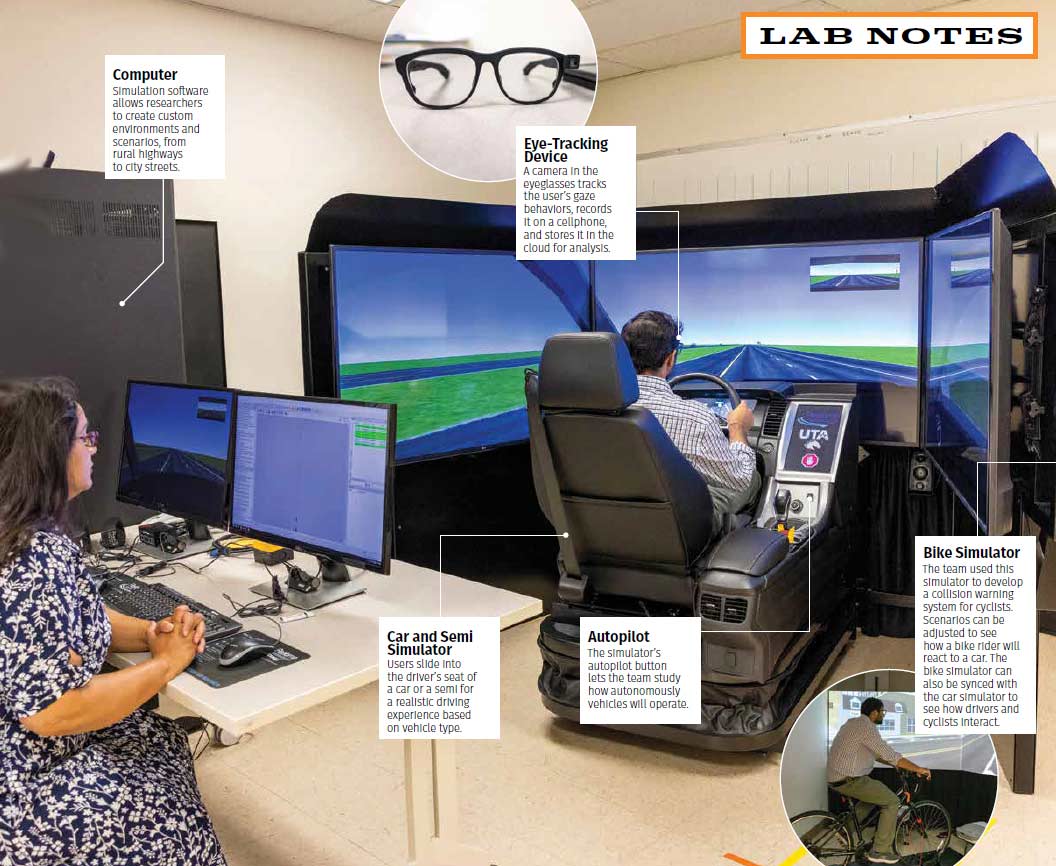
A man sitting in a driver simulator with a woman monitoring the data on a computer. Computer - Simulation software allows researchers to create custom environments and scenarios, from rural highways to city streets.
Embedded Microchip - Patients could be responsible for their own health records by using RFID technology to scan a microchip embedded in their body.
Car and Semi Simulator - Users slide into the driver's seat of a car or a semi for a realistic driving experience based on vehicle type.
Eye-Tracking Device - A camera in the eyeglasses tracks the user's gaze behaviors, records it on a cellphone, and stores it in the cloud for analysis.
Autopilot - The simulator's autopilot button lets the team study how autonomously vehicles will operate.
Bike Simulator - The team used this simulator to develop a collision warning system for cyclists. Scenarios can be adjusted to see how a bike rider will react to a car. The bike simulator can also be synced with the car simulator to see how drivers and cyclists interact.
Click to Enlarge

Simulating Driver Fatigue

If you've ever driven for long periods of time, you know that fatigue can creep up on you. At UTA's Human Factors Lab, Shuchi Deb is using virtual reality to study driver habits and learn more about fatigue in an effort to identify where machine learning and other technology could make roadways safer.

"We are developing simulations and creating scenarios that help us to identify ways to improve performance and behavior," says Dr. Deb, an assistant professor in industrial, manufacturing, and systems engineering. "With our simulators, we can design scenarios to help drivers monitor fatigue and see how long it takes them to fall asleep or lose track of their surroundings. Based on our data, we can then design a warning system with machine learning to alert drivers that their skills are degraded and they need to rest."

She and her team also have worked on several virtual reality projects, including an education platform for agriculture science students at Mississippi State University that allows them to manage conditions in a greenhouse, such as watering, humidity control, and light.