
Cultivating a Lab Culture
Building a robust research laboratory at a university is challenging. A successful lab director must raise money to purchase necessary equipment, write grant proposals to generate consistent funding, and—most importantly — recruit talented personnel to assist with the research and contribute their own ideas.
Though some directors are able to secure enough funding to cover salaries for postdoctoral researchers and multiple doctoral students, those positions are limited and competition is fierce among students. That makes it all the more notable that mechanical and aerospace engineering Professor Ashfaq Adnan has been able to build a pipeline of talented students for his Multiscale Mechanics and Physics Lab over the years. By finding mutual interests with students and parallels they not have recognized between his work and their own, he has created a family atmosphere in which all his students— from undergraduate to doctoral—can flourish as mentors, supporters, and researchers.
Brain Matters
"It is motivating to me to give opportunities to students with open minds," Dr. Adnan says. "My research is interdisciplinary, so my student researchers are all going outside their conventional comfort zones and trying something new. It's important to instill that mindset because it can lead to some very interesting results."
The Multiscale Mechanics and Physics Lab investigates multiscale mechanical behavior of engineered and biological materials to develop advanced materials for structural and biomedical applications and predict failure and fracture properties of nano- and biomaterials. This includes biomechanics, material design, high-speed experiments, and advanced manufacturing. Current projects focus on the neurobiology of brain injury, cavitation-induced damage in neuron and extracellular matrix, the mechanics of soft polymers and advanced composite and cellular materials, and sensors for protection and injury sensing.
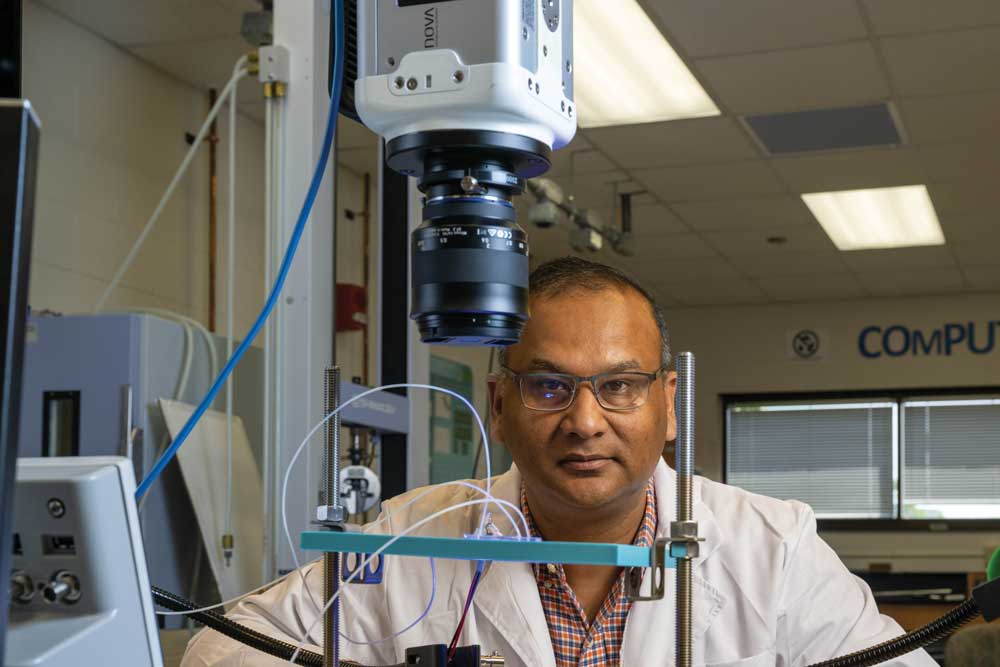
For example, a recent grant is supporting Adnan's effort to collect data connected to the rapid acceleration and deceleration of the head, then mimic it in a lab setting to determine the effects it has on the brain. Rapid acceleration and deceleration events include things like the impact of a speedboat traveling at high speed through waves, blows suffered during contact sports, and shockwave injuries on the battlefield.
Curiosity Welcome
Many of Adnan's students had studied related concepts before joining the lab, but had no idea that what they learned could have applications in combatting traumatic brain injuries. For instance, Ibrahim Hossain worked for a company that built ships for the Bangladesh Navy and was doing research involving motion tracking with sensors and cameras. Over the course of a short conversation, Adnan realized that Hossain's research could be helpful to his own and convinced him to bring his expertise to the lab.
"What do boats have to do with the brain? It may appear that they have nothing to do with each other, but a small conversation can lead to big ideas," Adnan explains. "I thought, 'how can I bring the motion of boats to my lab?' and realized that Ibrahim was able to track anything that moves, and that information could be valuable to determining what effects motion has on living cells."
Another student, Richie Daru, was working for a company that was developing technology with signal processing to detect stealth aircraft by the airflow around their rudders.
"I contacted Dr. Adnan and asked him if there was anything that I could work on in his lab," she says. "He determined that I could apply my knowledge of signal processing to biological signals in EEGs (a test that measures the electrical activity of the brain) and other sensors. I was surprised by how similar the technology is to radar, but with brain waves."
She stayed with the lab for more than just the research it offered, though.
"When I first came to UTA, whenever I had questions about what courses to take or how to handle the pressure of being a graduate student, there was always someone there. It gave me the courage to step up."
Homegrown Talent
In addition to bringing in graduate students from other universities, Adnan has also convinced several students to enroll in the BS-to-PhD or Fast-Track Master's programs, cultivating homegrown students to contribute their knowledge to the lab.
Tiger Koster joined as an undergraduate summer intern in 2019. Adnan was his professor in a course and had invited students to see him after class if they were interested in learning more about his research. Koster was the only one who did, and he eventually entered the Fast-Track Master's Program and, later, doctoral studies. He recruited his roommate, Aaron Jackson, to work in the lab as well.
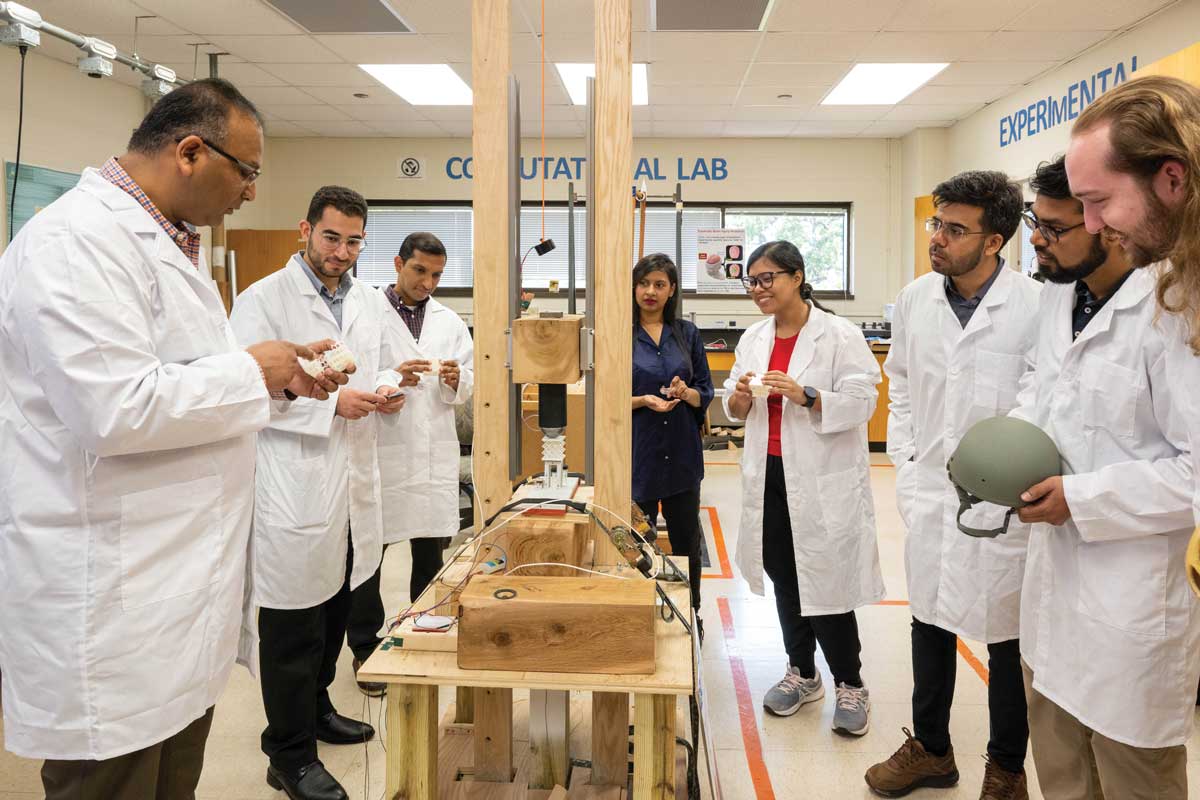
"There's a really good culture of mentorship here. You're never alone—there's always someone to help. That mentorship is a big reason I continued to work with Dr. Adnan," Koster says. "Aaron and I were the youngest students as undergraduates, and now we're the most senior. The fact that you're not just thrown in and you can get help and guidance is a big deal. When you have a great mentor, you want to give back. I realized how impactful that was and I'm happy to contribute in that way now."
Jackson planned on majoring in bioengineering when he came to UTA but changed his major to aerospace engineering at orientation because someone told him he wouldn't make much money unless he earned his PhD. His work with Adnan has allowed him to return to his passion as a doctoral student, applying aerospace engineering concepts to bioengineering applications.
"Dr. Adnan told Tiger that it's always best to work with your friends," Jackson says. "The culture here was a large factor in my decision to continue."
A Welcoming Culture
Adnan's success in finding students to work with him has gained the attention of at least one of his faculty colleagues, Professor Zhen Xue Han, who is also the aerospace engineering undergraduate advisor. He has sent two students Adnan's way in recent years, and both are pursuing master's degrees now.
"Research wasn't on my planned path," says one of those students, Tina Ko. "I wanted to do an internship instead, but Dr. Han recommended that I talk to Dr. Adnan first. Dr. Adnan gave me insight into how research could benefit me, and now I see that he was right—research has helped me look at challenges differently."
Ko's friend, Yukti Shinglot, got the same recommendation from Han.
"I had spoken to several professors about working with them, but Dr. Adnan stood out because he really helped me understand his research," Shinglot says. "The group culture appealed to me. As I got closer to graduation as an undergraduate, I knew there wouldn't be a better place to get my master's degree."
Once Adnan adds students to his lab, he remains actively engaged with them beyond working hours, showing genuine interest in their growth and success. He hosts lunch for everyone in the lab each semester and encourages them to bring friends or significant others to make working in the lab more like a family experience. Additionally, he tries to choose restaurants that serve food from everyone's background so they can experience a little bit of each other's home country.
"Sometimes research is frustrating, and you want to give up. But when you realize it's your baby, it gives you a reason to keep going," says Maliha Fairuz, a doctoral student. "Working in this lab, I have the comfort of being in a family. This is my work, and no one will push me to finish—I have to do it to get the most out of it. I've had a lot of support and good and interesting experiences that I'll take to the next stages of my career."
It is those relationships that make the biggest difference, Adnan says, because the sharing of ideas often leads to exciting new paths.
"I tell everyone that they need to graduate with full independence and confidence in their ability. I want my students to take leadership of the research program rather than me telling them what to do," he says. "At the beginning, such a mindset could be less productive, as there is always a learning curve, but in the end the outcome is rewarding. Often, my students educate me more than I educate them."
Koster agrees, adding that watching and contributing to the success of others can be very inspiring.
"Success inspires success. When you see people doing really impactful work, you want to do the same." ₪