Engineering in the Field
Through dedicated resources and expanded programs, the College of Engineering is preparing students to succeed in their careers after graduation.
These days, anyone entering the engineering workforce is expected to have hands-on experience. To better help its graduates meet this demand, the College of Engineering has expanded the opportunities available for students to gain real-world engineering skills. Through internships and co-ops, research projects, and capstone courses connected to industry, they learn how to apply the engineering process, meet deadlines, and work with clients, just like they will after they graduate and start their careers.
Internships and Co-Ops
Co-ops and internships give students practical work experience in their respective academic disciplines. Internships are usually completed by undergraduates but are also available for graduate students. The college collaborates with hundreds of local employers to place students in part-time positions to continue their usual course loads or full-time positions over semesters.
Carole Coleman leads the undergraduate engineering co-op and internship program. She helps students identify and apply for internships and offers workshops and online resources on career planning, résumé writing, interviewing techniques, and job-search strategies.
Through the college's Kelcy Warren Career Experience Center, Coleman and her staff facilitate two engineering-only career fairs each year where students can find internship positions. They also bring employers to campus for special events and spotlight days, which allow them to directly speak to students about open positions in a smaller setting than the career fair. All Coleman's efforts are aimed at helping students find an opportunity that fits their career goals.
“In college, you learn enough to get employed, but an internship allows a student to learn if they will actually like the job they're looking at and to discover other jobs that they might be interested in,” Coleman says.“An internship puts a student directly with an experienced engineer who will mentor them and get them started on the basics of a certain industry. They learn how to be an engineer and how to work in that industry.”
Justin Hawthorne ('25 MS, Software Engineering; '20 BS, Aerospace Engineering) completed a co-op at Walt Disney World in Florida as an undergraduate student at UTA. He said the one-on-one time with Disney engineers was instrumental.
“There was one job where a pipe needed to be fixed, but it's hard to do when it's underground,” Hawthorne recalls.“I suggested moving the pipe above ground and camouflaging it with landscaping, and the engineers adopted my suggestion. Another time I designed a new water backwash filtration system for an area in Epcot, and I got to share the updated procedures with the maintenance team.”
He has no doubt that his first job after graduation came as a direct result of his co-op experience.
“It's the reason I got hired. If not for my co-op experience, I wouldn't have been hired as quickly or easily,” he says. “I tell everyone I can that if they are able to get an internship, I highly recommend they do so.”
Innovation Day and MavPitch
In a meeting last spring with representatives from local industry, engineering Dean Peter Crouch heard over and over that companies are looking to hire students who have soft skills such as the ability to communicate effectively and work with a team.
The college provides two excellent opportunities for students to do just that. Innovation Day and the MavPitch competition put students' work in front of the world to show the quality and creativity of their research and to allow them to perfect their soft skills before they begin their careers.
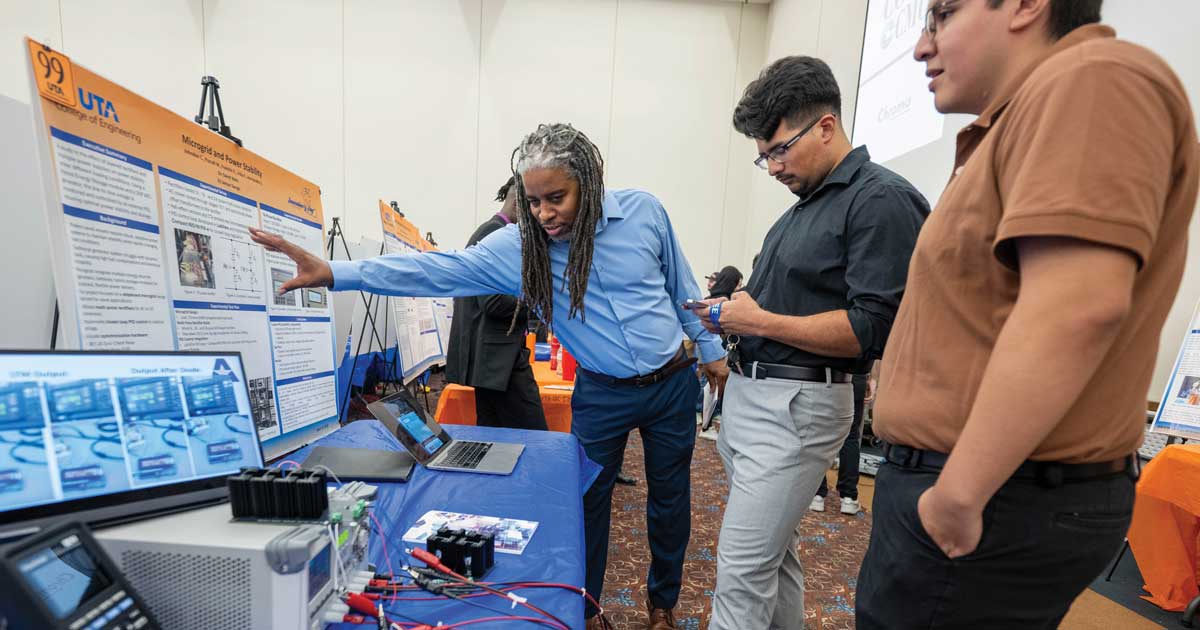
Innovation Day celebrates and showcases the innovative, transformative research and undergraduate capstone projects created by College of Engineering students. Community members and industry leaders are invited to participate and observe the depth and breadth of research occurring at UTA. In fact, projects are judged online prior to the in-person event, which has allowed alumni and others from far-flung places such as London and India to participate as judges.
Entries are divided into three categories: undergraduate research, consisting of funded Research Experiences for Undergraduate (REU) projects and projects performed with faculty outside the REU opportunity; graduate research; and senior design projects encompassing nearly every undergraduate major. In 2025, more than 400 students presented 111 projects.
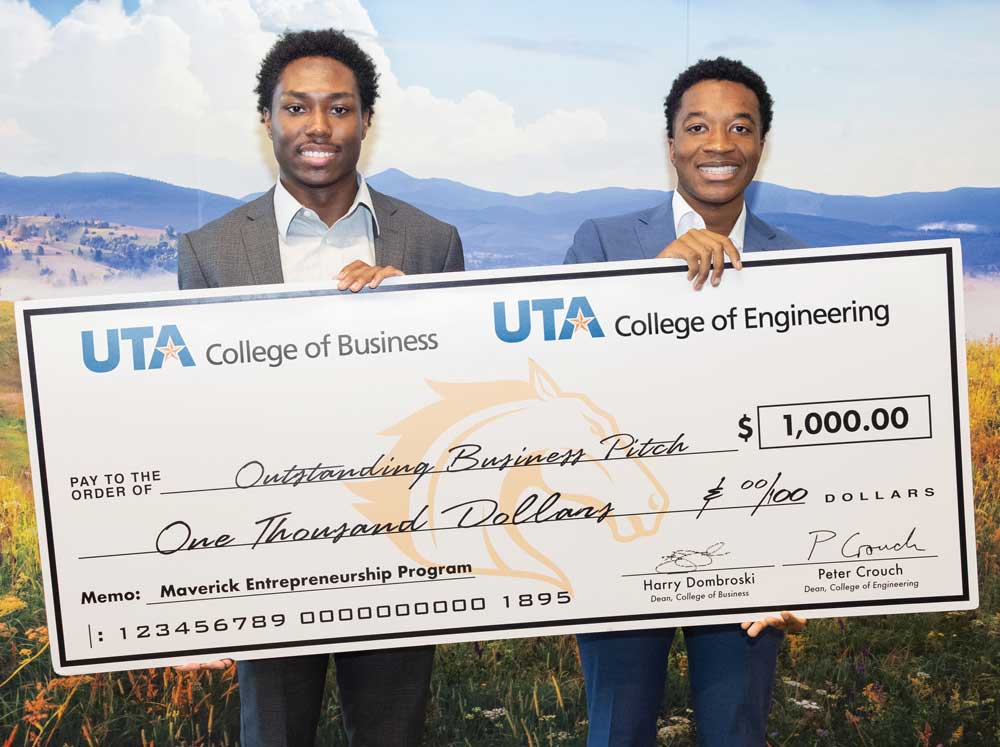
The Maverick Business Pitch Competition enables students to explore and express their business ideas in a friendly and encouraging environment. It is open to all UTA undergraduate and graduate students, who can either compete alone or in teams of up to four. In the first round, participants submit a three-minute video describing their business idea. A panel of judges reviews the pitches and selects those who will be invited to present a live six-minute pitch for a chance to win up to $15,000 in venture development funds in future semesters. Successful pitches are then invited to make a second pitch for additional funding up to $40,000.
Engineering students have done very well throughout the competition's history. Last year alone, the four finalists awarded the highest amount of funding, $40,000, were all engineering entries.
Senior Capstone Projects
Engineering students spend hours in class learning how to design, program, and build solutions to real-world problems, but no amount of class time can replace hands-on experience. Many UTA students participate in research with their professors, and a senior capstone course—better known as “Senior Design”—is required of all students prior to graduation. Most of these projects have some sort of industry involvement, ranging from mentoring teams to providing funding.
Mechanical engineering students Josh Nevarez, Victor Urena, Yoni Arias, Fatima Alaredhi, and Jose de La Torre worked with Houston-based Nitroset, which makes a solid propellant fastening system that uses the energy of its own solid propellant to drive fasteners into concrete rather than a traditional primer and gunpowder.
“We're going to be design engineers, so it's important to be able to take a concept through the design stage to a final product.”
“Our 'Design for Manufacturing' class really helped with this project,” Nevarez says. “Because of that class, we knew how to get our sketches approved, how to model and run simulations in CAD for our final concept, how to create the final design of the parts we made in the UTA machine shop, and how to assemble the machinery.”
Beyond the experience working with an industry sponsor, the team gained valuable insight into what it will be like when they enter the workforce as engineers.
“We're going to be design engineers, so it's important to be able to take a concept through the design stage to a final product,” Urena says. “This was a good example of giving a group of people a project and working together to get it done.”
Inside a Capstone Project
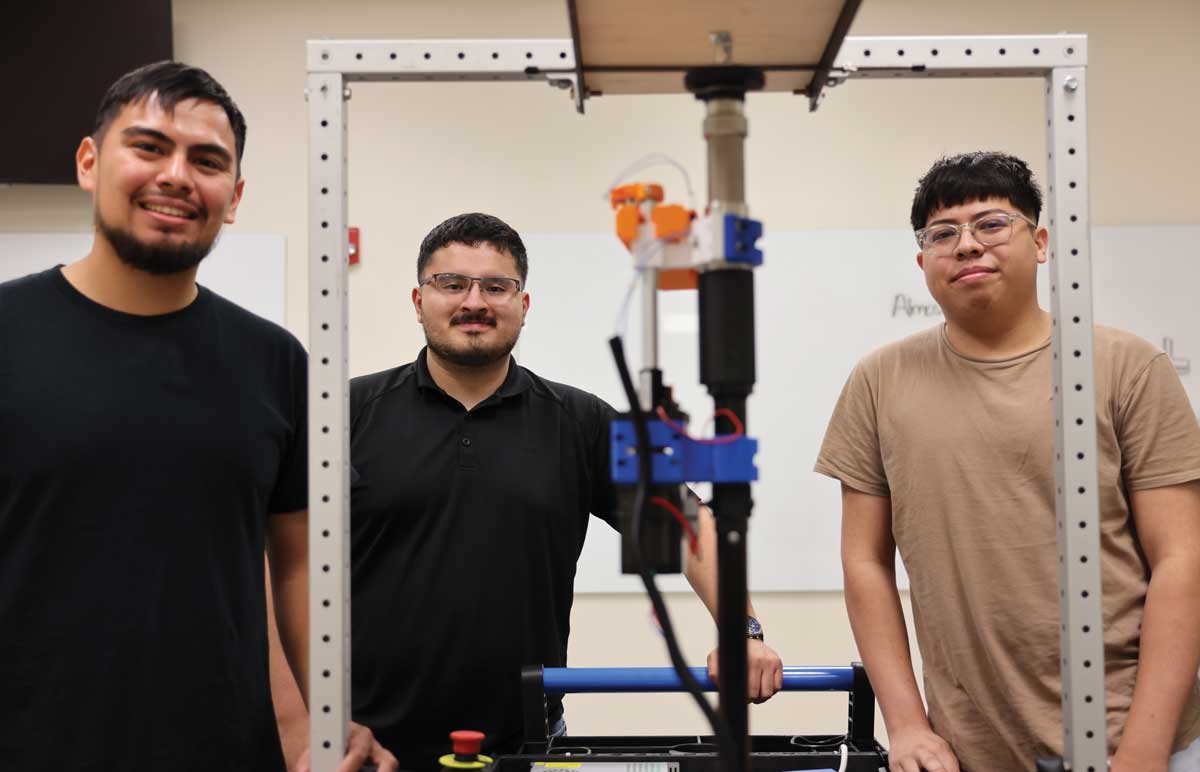
Students: Josh Nevarez, Victor Urena, Yoni Arias, Fatima Alaredhi, and Jose de La Torre
Faculty Advisor: Raul Fernandez
Company: Nitroset
Nitroset asked the team to automate one of its standard utility carts to move, fire, and reload the fastening tool. The company provided the materials they would need to fulfill these objectives.
The students developed a portable demonstration piece for Nitroset to use at trade shows to highlight its fastening tools, which customers typicallyuse in overhead applications such as fastening wires to ceilings to hold tile framing.
The cart they designed moves back and forth with a motorized wheel. It can hold eight Nitroset utility clips and automatically fire and reload them into a wooden surface. To enhance the demonstration experience, the team also developed a simulated ceiling assembled at eye level for easy viewing during operation. The tool, mounted on the cart, can fire the utility clips into a wooden plank.
The cart is equipped with a keypad interface, allowing Nitroset to initiate operation cycles easily. Each cycle can fire two to four utility clips, with an average runtime of approximately two minutes. ₪