
Power On
David Wetz and the UTA Pulsed Power and Energy Lab are helping the U.S. Navy create a smarter, safer, and more sustainable energy future.
For years, the U.S. Department of Defense (DoD) and its contractors have made significant investments in standing up and maintaining facilities to study energy storage and power and energy systems. University laboratories have benefited greatly from this partnership—including the Pulsed Power and Energy Lab (PPEL) at The University of Texas at Arlington.
Under the direction of electrical engineering Professor David Wetz, PPEL has spent the past decade-plus working with the Office of Naval Research, Naval Sea Systems Command (NAVSEA), and other DoD organizations, laboratories, and contractors to study energy storage and its use in power systems aboard future Navy ships.
A History of Success
Since its founding in 2010, the lab has performed a great deal of work on energy storage such as batteries and capacitors at the component and system levels. PPEL's niche has been the evaluation of how these technologies operate, heat thermally, and age when they are used to supply power at higher rates than are typically seen in consumer electronic devices.

Starting in 2018, the lab began to scale up its studies to include the integration of those storage devices into intelligent power systems—typically known as microgrids—that are very tightly monitored and controlled. Since then, the lab has operated a roughly 2 megawatt testbed, called the Intelligent Distributed Energy Analysis Lab, that studies Navy-platform-relevant voltages at lower power than would be installed on a ship. The success of that work has allowed the lab to grow and expand.
Recently, with support from NAVSEA, the PPEL has begun to stand up a new Power and Energy Innovative Research (PEIR) lab that will house a power system architecture that operates both at Navy-relevant voltages and power levels. With this facility, the PPEL is creating a testing environment to study future Navy power system architectures, control systems, and innovative power system technologies developed by power and energy vendors and contractors.

PEIR will operate multiple full-sized generators that are interconnected and controlled to source loads that emulate those on board a ship. This will allow Dr. Wetz and his team of researchers and students to simulate the operation of a Navy ship employing traditional and next-generation loads so they can identify and reduce potential risks before they are introduced into a ship.
Through additional pending support from the Operational Energy-Innovation (OE-I) program within the Office of the Undersecretary of Defense for Acquisition and Sustainment, the PPEL is also developing an Operational Energy Innovation Laboratory (OEIL). The team will be able to use OEIL's many resources to train engineers in power and energy technologies across the DoD's services and transition those technologies to the warfighter. The OEIL is intended to be a flexible and agile test laboratory where new OE-I technologies will be designed and studied, technologies designed by other OE-I performers will be studied, and end-use warfighters will be given an opportunity to gain hands-on experience with the technologies.
Elevating UTA's Repuatation
“When I started the lab in 2010, we were looking at individual battery cells and studying small generators that can be bought at the local hardware store. Now, we are operating high-voltage batteries intelligently controlled alongside Navy tactical generators supplying multiple megawatts of power,” Wetz says. “It's an amazing opportunity for our students and the warfighters to understand how power and energy technologies scale and improve the DoD's superiority on the battlefield. We want to help the DoD transition concepts into relevant power systems while also helping them to overcome risks before they can become a problem on a platform.”

The addition of PEIR and OEIL elevates UTA as a major partner of the DoD, and it strengthens the University's ability to contribute to the engineering workforce while creating industry partnerships.
From an industry standpoint, PEIR creates natural opportunities to work with major companies that supply power generation, conversion, and storage technologies to both DoD and civilian sectors. PEIR will enable both the company and the sponsor to evaluate their technology in a flexible but relevant lab environment. Wetz and his team can provide test data from the equipment to the stakeholders to enable them to continue to improve their products for the DoD. PEIR will also have future potential to work with allied foreign governments on similar systems, which will create opportunities to work with international companies, greatly expanding UTA's footprint on a global scale.
Raising Student Research
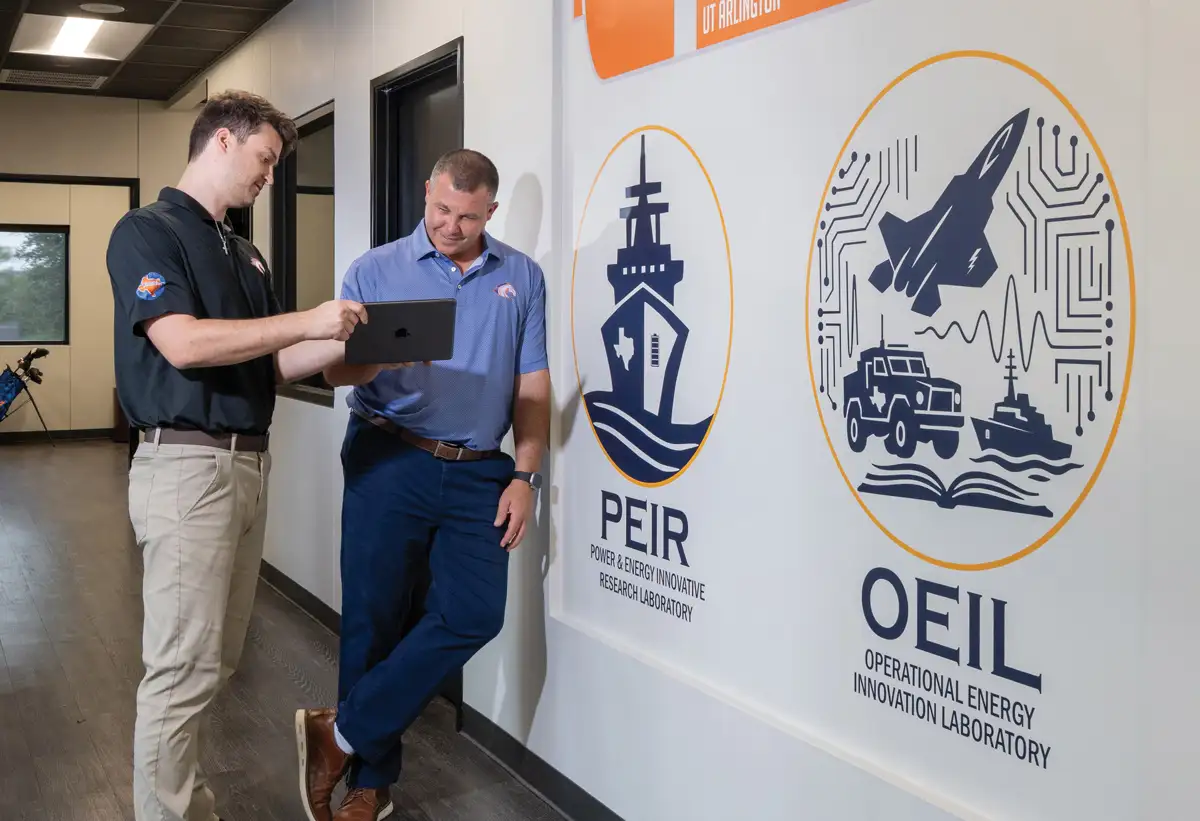
The projects supported by the PPEL (PEIR, OEIL, and the Intelligent Distributed Energy Analysis Lab) require a full complement of undergraduate students, graduate students, and research staff.
As a student at UTA, Alex Johnston ('22 PhD, Electrical Engineering) focused his research on standing up and operating the Intelligent Distributed Energy Analysis Lab testbed in support of the Office of Naval Research. After graduating, he joined the PPEL as a postdoctoral fellow from 2022-23, as teaching faculty from 2023-25, and now as a tenure-track assistant professor. His expertise in power system modeling and control is already well-recognized by PPEL's sponsors and will help the lab to continue its growth.
Juan Rodriguez, a 2008 UT El Paso graduate, joined as the lab's scientific engineering manager in November 2024. Soon, Zach Shaw, a 2021 Texas Tech University graduate, will join as a research scientist. They bring a great deal of depth and capability to the lab's daily operations and research thrusts.
Education Partnerships
Wetz and the Navy have had formal Education Partnership Agreements with the Naval Surface Warfare Center-Philadelphia Division and the Naval Surface Warfare Center-Dahlgren Division since 2018 and 2019, respectively. These have enhanced research and education at UTA through interactions with the divisions' personnel and enabled the sharing of scientific, engineering, and technological assets.
In addition, the agreements let Navy researchers involve UTA faculty and students in their research projects, loan equipment to the University for educational purposes, and potentially develop and teach science and engineering courses at UTA. It also allows more collaborations across the full spectrum of naval technology. Wetz was instrumental in creating both partnerships.
“These agreements resulted from UTA's long history of obtaining grant funding from the Office of Naval Research for projects that directly support ongoing efforts at the Naval Surface Warfare centers,” Wetz says. “We are so grateful for them recognizing the potential impact our faculty and students offer. This is a college-wide opportunity that benefits everyone involved.”
More Research Avenues
Though most of the PPEL's work centers on advancing power and energy technologies for DoD platforms, the lab also has research thrusts in the areas of pulsed power, dielectric breakdown of materials, arc flash of DC energy storage sources, and dielectric creepage and clearance across insulator boundaries.
One of PPEL's notable collaborations involves a project with an Austin-based company to develop specialized high-voltage hardware to evaluate the creepage and clearance of insulators that are exposed to harsh power system environments. The end goal is to equip the warfighter with an easy tool it can use to determine if the electrical holdoff potential of its insulators has been compromised by the environment over time.
In a related effort, PPEL has conducted extensive studies for the Office of Naval Research into the pulsed electrical breakdown of epoxy insulator materials that are dielectrically altered using nanoparticles. The aim is to identify solid dielectric insulators that boost the power and energy density of pulsed power systems while reducing maintenance demands.
PPEL has also taken a forward-looking approach to energy storage. The lab has worked with commercial vendors producing sodium-ion and nickel-zinc batteries as potential alternatives to lithium-ion energy storage technologies. These options show promise for both DoD and civilian applications that demand high transient power, potentially offering safer or more cost-effective solutions.
Battery safety, particularly during maintenance or fault conditions, remains a top priority. In collaboration with the Electric Power Research Institute and Office of Naval Research, PPEL has been studying the phenomena of DC arc flash. With some systems reaching as high as 1000 volts direct current, understanding and mitigating risks is mission-critical.
In addition to supporting current technologies, PPEL is also playing a role in shaping future defense capabilities by analyzing the performance limits of commercial electric vehicle batteries when they are subjected to the higher power demands of military applications.
Together, these diverse initiatives highlight the breadth and depth of PPEL's commitment to advancing energy technologies for today's defense needs and laying the groundwork for a smarter, safer, more sustainable energy future. ₪