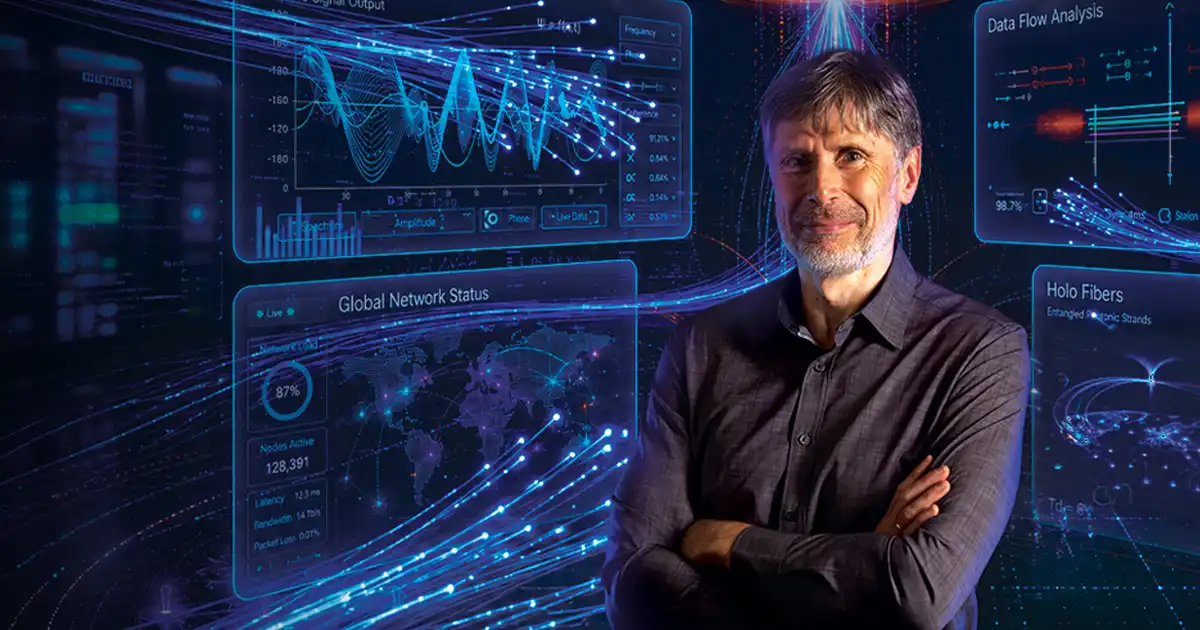
A Quantum Leap
UTA researchers are helping usher in a second quantum revolution.
On the cusp of the second quantum revolution, the College of Engineering is expanding its research in the field.
The word quantum describes the smallest possible amount of something—the most basic building blocks of matter, energy, and light. These building blocks are special. They may appear to be in two places at once, affect each other from great distances, or even pass through barriers that they should not be able to pass through.
These characteristics are part of the field of quantum mechanics, which was developed by scientists more than a century ago because they could not explain these natural phenomena any other way. Quantum mechanics also forms the basis for powerful technologies that are being used to develop unhackable communications, faster discovery of new drugs in the medical field, powerful computing, and countless other cutting-edge technologies.
There is a consensus in the field that we are in the second quantum revolution. The first was driven by the discovery of quantum physics in the first half of the 20th century; the second half of the century produced technology breakthroughs such as integrated circuits, nuclear energetics, and lasers. The second quantum revolution focuses on characteristics of quantum mechanics called quantum entanglements (where quantum objects interact even if separated by large distances) and superposition (where objects can exist in one or more locations at the same time). The manipulation of these techniques is the backbone of the current revolution. Their characteristics are not easy to observe because they involve photons and electrons, but they create a number of possibilities for technological advances.
A National Initiative
In 2018, the United States created the National Quantum Initiative, pumping billions of dollars into a program designed to accelerate research in quantum technologies and ensure that the U.S. would be a world leader in the field. The initiative connects government agencies, industry, and others to expand knowledge and build research and development capabilities.
This has made it easier for large high-tech companies to invest in quantum technology through internal research and by funding startups that are mostly focused on quantum computing.
The initiative has also benefited universities trying to scale up or transition their research to quantum products. Previously, university researchers trying to start a company had to look for funding from venture capitalists. Now, more funding options are available, and researchers can take chances on developing riskier technologies because the funding timeline is extended to a five- to 10-year horizon rather than the short one- to three-year timeframes demanded by venture capitalists. This has led to a great deal of progress in a short time in the push to develop quantum computing.
Bigger in Texas
Many states have invested in bringing their colleges and universities into a competitive position in the quantum space, with several states investing hundreds of millions of dollars to build infrastructure and create startup ecosystems. In September 2025, Illinois, Maryland, and New York announced a total of $1.8 billion in investments in quantum research, including regional quantum networks and infrastructure.
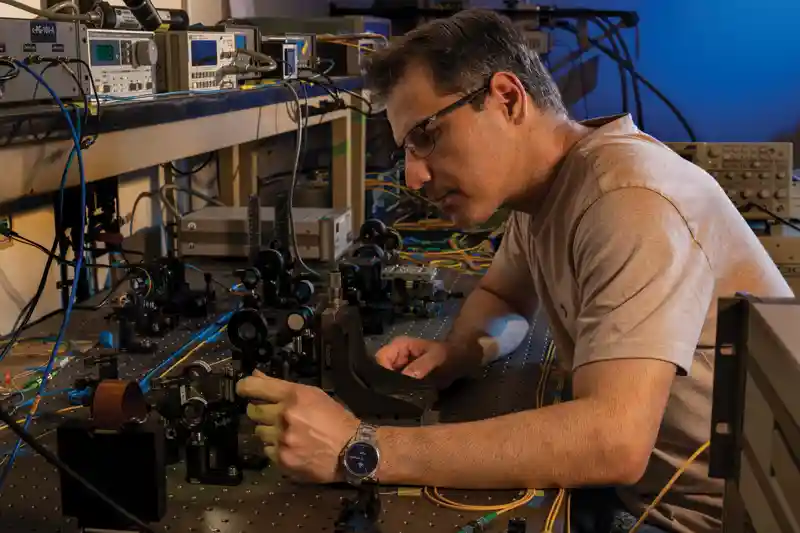
Not to be outdone, Texas passed its own Texas Quantum Initiative last year to position the state as a national leader in quantum technology. While not yet funded, the initiative aims to create a quantum ecosystem in Texas to bring together universities and industry to facilitate quantum startups and quantum workforce development. Several Texas quantum centers and institutes have sprung up since, each with a different focus—UT Austin in novel materials and UT San Antonio in cybersecurity, for instance—and UTA has started its own with faculty from the College of Engineering and the College of Science, aiming to build up the North Texas region as a testbed for quantum technologies.
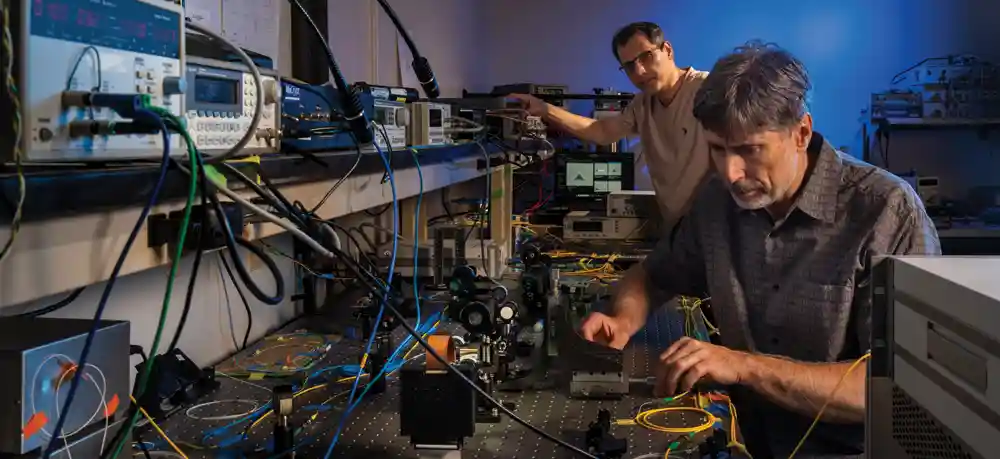
“We want to build on our strengths for our quantum research. UTA has exceptional strengths in photonics and quantum communications. We also have people working in areas such as novel quantum materials and quantum simulations. We have been hiring faculty to strengthen our research in integrated photonics devices, as well as quantum networking and quantum applications,” says Michael Vasilyev, a professor of electrical engineering and one of the drivers of UTA's Quantum Initiative.
“In addition, we are engaged in the local Dallas-Fort Worth ecosystem with SMU and UT Dallas, along with industry, to create a regional quantum network that could become a driving force for spinning off small companies and attracting large companies to do experiments and field trials of their technology on the network,” Dr. Vasilyev continues.
The Future is Quantum
Quantum research may sound like a science fiction pipe dream, but there are very real potential applications for quantum technology that stand to lessen the impact to the environment from data centers, improve the security of communications, and design new molecules.
According to Vasilyev, the high-tech community believes that quantum will be the next step after AI. Quantum processing will accelerate certain tasks in AI workflows beyond what is possible with a CPU or GPU, so many companies are investing in quantum as green tech to prepare for the next step in the data center road map.
Data center electricity demand grew by 16-17% worldwide in 2025 and accounted for about 4% of energy consumption in the United States. Those numbers are climbing exponentially, and data centers could soon be the dominant source of energy consumption in the world. To keep up with demand, companies must build more power plants, which are bad for the climate and environment.
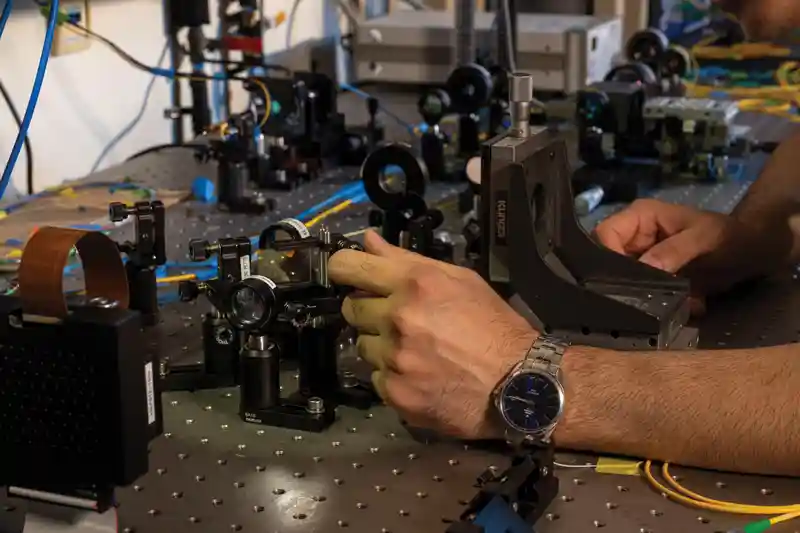
“This is not sustainable in the long run. Quantum computing can't beat classical computing in all tasks, but it can in some. Quantum could potentially be very good in optimization of large-scale tasks like training AI so that it can be done faster and more efficiently. This will help to reduce the strain on the power grid and lessen the impact on the environment,” Vasilyev says.
As quantum computing technology becomes more widely available, communications will become less secure, and it will be easier for bad actors to gain access to data. Breaking codes is difficult using classical computing but poses no challenge for quantum computers. The government is already requiring that some data transfers use a new type of encryption that is supposedly more resilient to quantum computers (so-called “post-quantum cryptography”), but there is no proof yet that it cannot be easily broken. On the other hand, the same quantum nature can be used to protect our data.
“The one foolproof way to secure communications is to use quantum communications,” Vasilyev explains. “We can use the quantum properties of photons so someone who taps into the message stream won't be able to get anything useful from it because of the fundamental laws of quantum mechanics.”Another possible quantum application is the modeling and design of new custom molecules, which could be used to make new drugs and new materials with targeted qualities for applications in healthcare and technology. This task would require an enormous amount of time with classical computers but could easily be accomplished with quantum computers.
What does all this mean? Big thinking about the most minuscule particles opens a vast universe of potential applications where imagination can become reality.
Support for quantum research at the national, state, and local levels continues to grow. The UTA Quantum Initiative will provide UTA researchers with support and opportunities for collaboration that could take their work to new levels and into exciting new directions. ₪