Robotic Assistance
Team Builds Robotic Exoskeleton to Help Workers
For workers whose jobs involve hours of lifting and repetitive motion, even small innovations can make a big difference in preventing future musculoskeletal disorders.
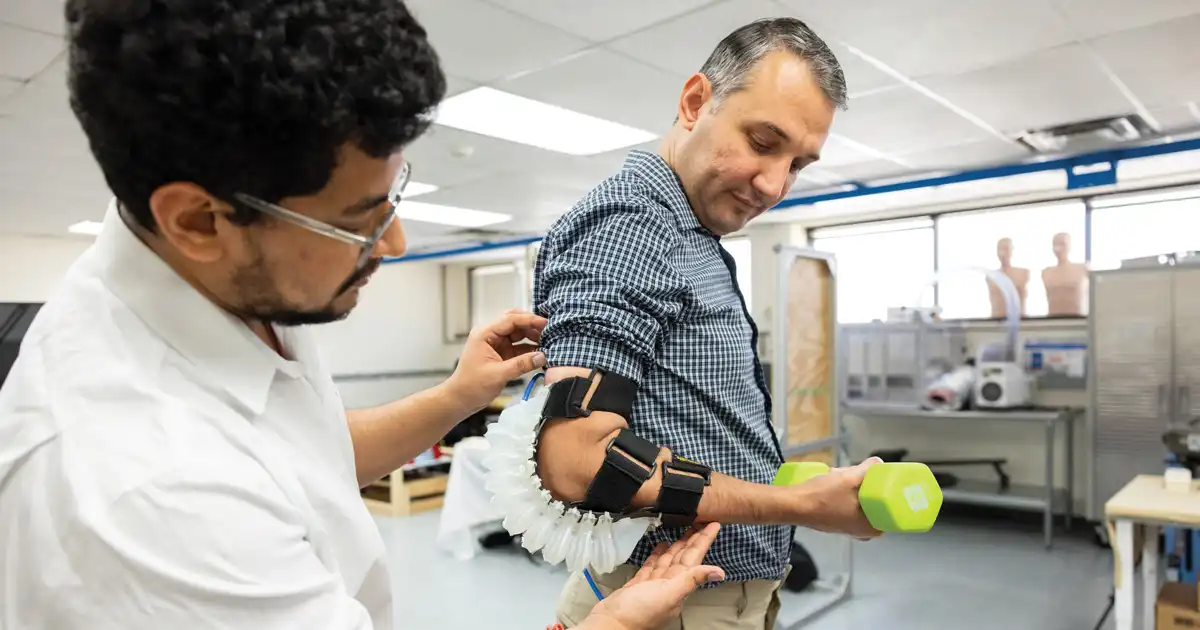
That's why UTA engineers have developed a soft robotic exoskeleton that lightens the load-literally-by reducing strain on the arm and elbow.
The device uses a lightweight silicone "pneumatic actuator" to assist movement during everyday industrial tasks such as lifting, assembling, and drilling.
"Our goal was to create a preventive, assistive device that reduces muscle strain before injuries occur," says Eshwara Prasad Sridhar, a graduate research assistant in the Department of Industrial, Manufacturing, and Systems Engineering. "By using the pneumatic systems already available overhead in most manufacturing facilities, this exoskeleton can be easily implemented in real-world settings." ₪