Helping Fight
COVID-19
In response to the COVID-19 pandemic, researchers in the College of Engineering have turned their attention to the current needs of health care workers.
In response to the COVID-19 pandemic, researchers in the College of Engineering have turned their attention to the current needs of health care workers.
When COVID-19 brought the world to a standstill earlier this spring, The University of Texas at Arlington—like thousands of colleges and schools across the country—had to quickly find a new way to deliver courses and do business. Within a week of deciding to suspend all campus activities, the University had moved classes online and administrative operations off campus.
All the while, researchers around the globe kept working to create a vaccine, develop reliable tests to identify people infected by the virus, and determine if any current medications could slow its spread. Many of these innovators conducted their work on now-empty university campuses, including two in the College of Engineering: industrial engineering Professor Erick Jones, who is developing rapid-response supply chains for medications, and materials science and engineering Professor Seong-Jin Koh, who is creating a portable device to provide COVID-19 test results in minutes.
“Clearly, the COVID-19 pandemic created problems around the world, not all of which are related to patient care and treatment,” says Peter Crouch, dean of the College of Engineering. “For months, we have had to find solutions to logistical issues around course delivery and caring for our students, faculty, and staff, and I think we’ve done well. On a grander scale, as engineers, we are in a unique position to help find solutions to these problems. I am glad that Drs. Jones and Koh are in the thick of the fight and in a position to impact communities in North Texas and beyond.”
Once he decided to pivot his research to the pandemic, it was natural for Dr. Jones to bring in the Houston Health Department, with whom he has a long-standing relationship. With his colleagues there, he is working with artificial intelligence to develop a rapid-response supply chain designed to quickly deliver COVID-19 medications, once they are available, to vulnerable urban populations in Texas.
This collaborative public health project among UTA, the city of Houston, and the National Science Foundation (NSF) has the potential to get needed treatments into the hands of the most critically ill and at-risk populations and prevent hospital facilities from becoming overwhelmed.
“We’ve seen that hospital capacity is being strained with elderly people or those with no other health care options,” says Jones, who is also associate dean for graduate studies. “If we could provide medications to the people who are most at risk and least likely to easily access them, it would free up capacity for people who need ventilators.”
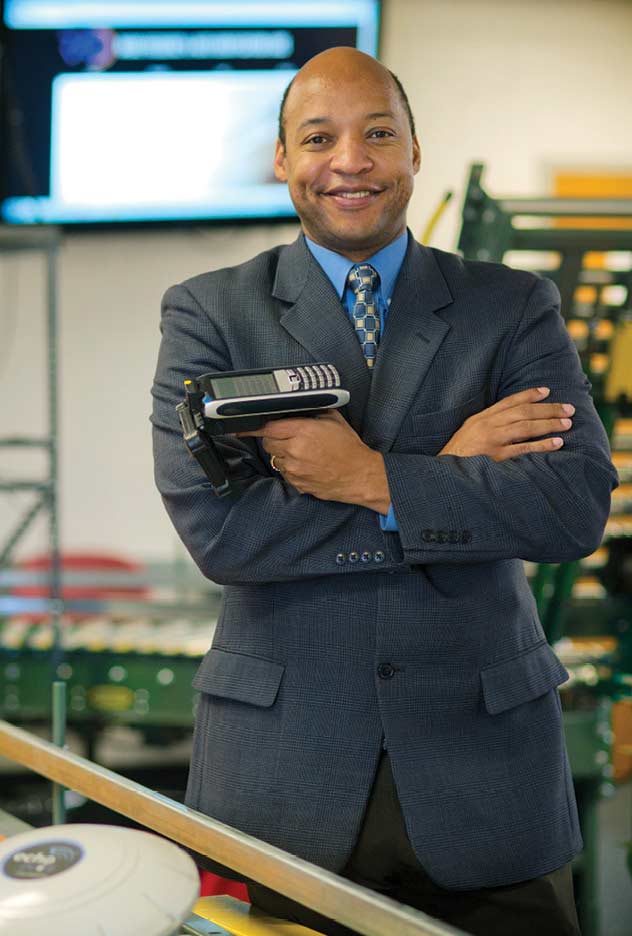
His team received a two-year NSF Early-Concept Grant for Exploratory Research for this work. Known as EAGER grants, these awards support research on untested but potentially transformative ideas or approaches, allowing recipients to rapidly test potential high-risk/high-reward ideas that could lead to more expansive research and innovation.
Jones is investigating methods that integrate AI, data science, and automatic data capture technologies to create a map showing where at-risk, underserved patients reside in Houston and how—and if—they are taking their medications. Once that is determined, he will design supply chains that safely and effectively deliver coronavirus medication to vulnerable residents. The goal is to create a real-time map that allows the Houston Health Department to supply medication to people who are critically ill first. It will also present a more detailed picture of who is at risk of contracting the disease or who may have contracted it.
“Ultimately, the Houston Health Department is trying to minimize impact and confirm that people are taking prescribed medications to lessen the risk that they’ll contract or spread the disease,” Jones says.
He previously worked with the health department to redesign its supply chains and is thus familiar with how social workers get medicine to underserved patients. COVID-19 has disrupted these processes, however, because in-person visits aren’t safe for social workers or patients. To mitigate this risk, Jones wants to design a process where anti-COVID-19 drugs, when available, can be delivered to a central point in a neighborhood for pickup. Once the patients pick up the medication, doctors or social workers could visit with them via telemedicine, verify that the medicine is correct, and watch them take it.
“The current worldwide health crisis caused by COVID-19 has caused a major disruption of the global supply chain,” says Paul Componation, chair of the Industrial, Manufacturing, and Systems Engineering Department. “Dr. Jones’ research could allow fast, safe, effective distribution of treatment for this disease to our communities’ most vulnerable populations, which could help save lives through early intervention and engagement.”
One challenge in the fight to contain COVID-19 is the time required to get test swabs to a lab for analysis and results, which can take days. But that may soon change, thanks to Dr. Koh’s newest project.
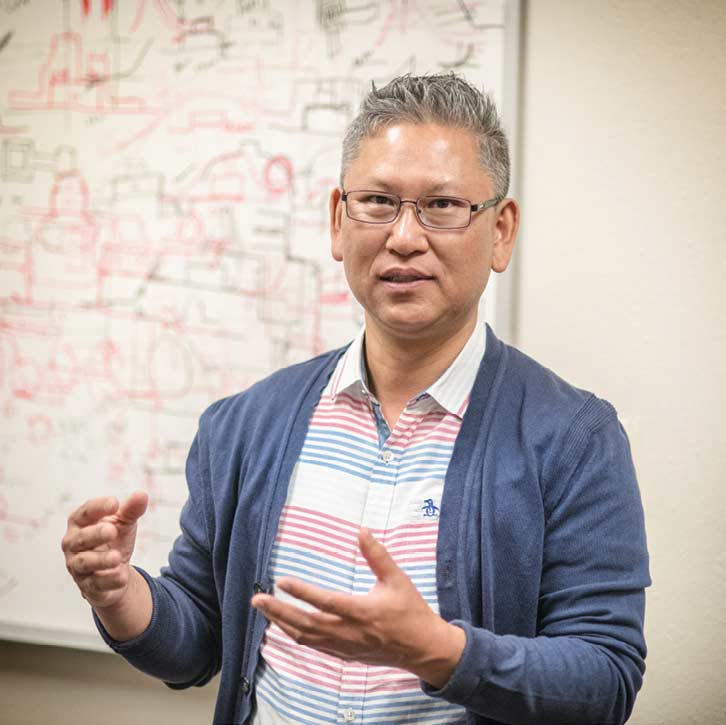
Using funding from an NSF Rapid Response Research grant—awarded for proposals related to topics of severe urgency with regard to the availability of or access to data, facilities, or specialized equipment—he is developing a device that is portable, efficient, and able to deliver results on-site in about 10 minutes. Once complete, health officials will test for COVID-19 by using the current swab collection method to extract a patient’s RNA, then insert it into the device.
About the size of a thumb, Koh’s device relies on nanotechnology on a 1-centimeter-square silicon chip populated with more than 1 billion nanowells. In the nanowell, a COVID-19 RNA strand is sandwiched between a capture nanoparticle and a detection nanoparticle. The capture nanoparticle is connected to a negative electrode, while the detection nanoparticle is connected to a positive electrode. Applying a voltage between the two instantly produces an electrical current. A lack of current means the COVID-19 strand is not present in the test sample.
“Our new technology will allow health officials to quickly and easily determine if a person is a COVID-19 carrier,” Koh says. “Because it is portable, the device could be used in airports and other high-volume locations.”
The device costs less than $5 per unit to fabricate and uses currently available silicon technology. This would allow it to be mass-produced by the millions daily, helping ease the demand for testing kits, according to Koh.
The device can also easily be adjusted to detect other illnesses simply by changing out the DNA strands on the capture and detection nanoparticles. This could be valuable in future outbreaks or with common diseases such as the flu.
“Dr. Koh’s findings in previous nanotechnology research related to electrical detection of ultra-low concentrations of DNA molecules have given him the ability to quickly develop a device that can immediately be put to use on a large scale on the front lines of this pandemic,” says Stathis Meletis, chair of the Materials Science and Engineering Department. “It is a good example of how we can draw upon knowledge at the nanoscale developed through previous research to combat real problems.”
The lasting effects of the coronavirus pandemic won’t be known for quite some time, but lessons learned and best practices developed in response to the experience will make the college more agile and receptive to new ideas in how it approaches delivery of courses.
In addition, the efforts of faculty like Jones and Koh stand to have an impact on communities long after the pandemic ceases to exist because their research can broadly be applied to other challenges and opportunities. Jones’ work could change how health care is provided in underrepresented communities and improve care for those who are unable to get to a physician’s office for treatment. Koh’s device could allow doctors to quickly and easily diagnose many diseases without long waits for lab results.
In the end, the coronavirus pandemic may have provided an impetus to new thinking, leading to health care innovations that benefit everyone.
“The COVID-19 pandemic, and the upheaval it has caused throughout our communities, has been challenging. We have been thrust into uncertain situations for the last several months, but I think as a whole the UTA community has responded admirably,” says Teik Lim, UTA interim president. “The contributions of researchers such as Drs. Jones and Koh are further evidence that the University will always stand tall in support of our community, and that innovation here on a local scale can have a ripple effect that will be felt globally.
“This is what scholarship, leadership, and community are about, and I am proud that UTA can be counted among those who are fighting to make a difference.”